.png)


This is a Paragraph. Click on "Edit Text" or double click on the text box to start editing the content and make sure to add any relevant details or information that you want to share with your visitors.

© 2025 Velah Sacred Truffles™ / The Chronicles of Chocolate City™
All characters, storylines, worlds, lore, names, and narrative elements are original creations of Sherry Hawkins. Unauthorized copying, adaptation, or use of this content is strictly prohibited.

PROLOGUE — “Velah, Guardian of the Light”
In the beginning, there was the Divine Mother.
Not a being with form—not yet—but consciousness itself, vast and loving, carrying within her essence the seed of all sweetness, all nourishment, all that would become chocolate.
She looked into the void and saw potential.
Not emptiness, but the space where something beautiful could grow.
And so she began to dream.
From her dreaming came Chocolate Earth—a realm woven from the very essence of cacao, where rivers ran with liquid chocolate instead of water, where soil was rich and dark and smelled of roasted cocoa and vanilla, where the air itself tasted sweet on the tongue.
But a realm without inhabitants is just landscape.
Beautiful, yes.
But incomplete.
So the Divine Mother created the First Cacao Tree—ancient beyond measure, its trunk wider than ten fairies standing shoulder to shoulder, its branches reaching so high they disappeared into clouds, its roots diving so deep they touched the realm's very foundation.
And from this tree—from the sacred pods that grew upon it, each one glowing with internal light—came the Four Great Houses.
Not all at once.
Sequentially.
Intentionally.
Each House emerging in its season, each carrying a distinct frequency, each necessary for the whole.
THE EMERGENCE OF THE HOUSES
First came the House of Browns — Earth and Memory
The southern pod split open at harvest time, when fields were heavy with abundance, when the work of tending and gathering reached its peak.
From this pod emerged the Browns—fairies whose skin carried the rich, warm tones of milk chocolate, ranging from light caramel to deep mahogany, all of it bearing subtle patterns that looked like bark, like living wood that had learned to walk.
Their wings were amber-gold, veined like autumn leaves, solid and powerful—built for endurance rather than speed, for carrying heavy loads across long distances, for the steady work of tending earth.
Their eyes were honey-brown that darkened with age and wisdom, becoming nearly black in the eldest among them, holding the accumulated weight of everything they'd witnessed.
The Browns were grounded—literally and energetically connected to soil, to roots, to the deep slow wisdom of things that grow. Their magic worked through touch—hands in earth, feet on ground, the patient tending that transformed seed into harvest.
And they were the first to establish what would become the sacred balance of Chocolate City:
Women as sovereigns. Men as shields.
The first Brown Queen was Terraya, and she understood immediately what the Divine Mother had intended: that nurturing power and protective strength were not the same thing, that both were necessary, that neither was superior.
So when the first Brown King emerged—Gareth, with shoulders broad as oak trunks and hands gentle enough to hold seedlings without crushing them—Terraya did not make him subject to her rule.
She made him Shield Consort.
Partner, not subordinate.
Protector, not property.
His role: to guard what she cultivated, to stand as the realm's first line of defense, to use his strength in service of growth rather than conquest.
Her role: to govern with wisdom earned through connection to the land, to make decisions that honored long-term thriving over short-term gain, to heal what was broken and tend what needed care.
Two roles.
Equally essential.
No competition.
Just clarity.
And from Terraya and Gareth came the first Brown village—children and grandchildren and great-grandchildren, all carrying that same rich brown skin, those same amber wings, all learning from birth that feminine wisdom and masculine strength were two halves of one whole, neither complete without the other.
Browns did not marry outside their House.
Not from prejudice, but from frequency—their magic was so deeply tied to earth, to the specific resonance of milk chocolate, that mixing with other frequencies created dissonance that made their gifts unstable.
So they married cousins, second cousins, distant descendants of the royal line—keeping the bloodline strong, the magic pure, the connection to earth intact.
Second came the House of Ivories — Light and Healing
The eastern pod opened at dawn, when the first rays of sun touched the highest branches of the First Cacao Tree, when darkness gave way to light.
From this pod emerged the Ivories—fairies whose skin was so pale it was nearly translucent, carrying an inner glow that made them look like they were lit from within, like vessels of captured moonlight.
Their wings were pearl-white, shot through with veins of silver and gold that seemed to move when you weren't looking directly at them, creating subtle rainbow refractions when light caught them at the right angle.
Their eyes were silver—pure, clear, luminous—but they changed with the moon's phases: darkening during new moons, brightening during full moons, carrying the tidal pull of Lunessa's influence.
The Ivories were elevated—not in status, but in frequency, their magic naturally reaching upward, working through breath and light and the clarifying force that made difficult truths visible.
The first Ivory Queen was Lumina, and she understood that clarity without compassion was cruelty, that seeing truth clearly meant nothing if you didn't honor what you saw.
So when the first Ivory King emerged—Soleth, with eyes that could look directly into wounds without flinching and hands that could hold pain without being destroyed by it—Lumina named him Shield Consort as Terraya had named Gareth.
His role: to protect the vulnerable during their healing, to create safe space for transformation, to use his strength to guard those whose defenses were temporarily down.
Her role: to witness what needed to be seen, to bring light to places that preferred darkness, to heal not by fixing but by holding long enough for natural restoration to occur.
And from Lumina and Soleth came the Ivory villages—children who learned that feminine illumination and masculine protection worked together, that you couldn't force healing but you could create the conditions where healing became possible.
Ivories did not marry outside their House.
Their magic was tied to frequency of light—specific wavelengths that corresponded to white chocolate's particular resonance—and mixing with other frequencies created interference patterns that made their healing gifts unreliable.
So they married within the bloodline—cousins, extended family, descendants of the royal line—keeping the light pure, the healing precise, the connection to Lunessa strong.
Third came the House of Semis — Air and Vision
The western pod opened at twilight, when day and night balanced perfectly, when the boundary between waking and dreaming grew thin.
From this pod emerged the Semis—fairies whose features carried the elegant bone structure of East Asian ancestry, with sleek black hair that seemed to move with thought rather than wind, with skin that ranged from pale ivory to warm gold. Their wings were semi-transparent, shifting between visibility and invisibility depending on the angle of viewing, creating the unsettling effect of seeing through them to something else, something just beyond normal perception.
Their eyes were the most remarkable—color-shifting, moving through violet, amber, silver, and rose-gold depending on their emotional state, their depth of vision, whether they were seeing this reality or one of the infinite possible realities they could access through prophetic sight.
The Semis were liminal—existing in the space between, comfortable with ambiguity, with multiplicity, with the understanding that all stories were true and false simultaneously depending on perspective.
The first Semi Queen was Mirabai, and she understood that vision without groundedness was delusion, that seeing infinite possibilities meant nothing if you couldn't choose which one to make real.
So when the first Semi King emerged—Kaelen, whose prophetic sight ran as deep as hers but whose gift was narrowing infinite options into actionable paths—Mirabai named him Shield Consort.
His role: to filter the overwhelming influx of possibility, to help translate vision into strategy, to protect dreamers from drowning in the ocean of what-could-be.
Her role: to see what others couldn't, to hold the realm's collective dreams, to weave stories that shaped reality by being told. And from Mirabai and Kaelen came the Semi villages—children who learned that feminine vision and masculine discernment worked together, that dreaming and doing were equally necessary.
Semis did not marry outside their House.
Their magic was tied to the specific frequency of air—the particular resonance of semi-sweet chocolate that existed between milk and dark—and mixing with other frequencies created confusion that made their prophetic gifts unreliable, showing futures that couldn't actually manifest.
So they married within the bloodline, keeping the vision clear, the dreams coherent.
Fourth came the House of Cocos — Fire and Transformation
The northern pod opened during volcanic night, when the realm's core heat rose to the surface, when earth itself remembered it was made from fire.
From this pod emerged the Cocos—fairies whose skin was the deepest brown-black, so dark it seemed to absorb light rather than reflect it, marked with patches that looked like healed burns, like places where fire had touched and left its mark. Their wings were garnet-red at the base, fading through copper and bronze to molten gold at the tips, and actual flames danced along their edges—not metaphorical, not magical illusion, but real fire that burned without consuming the wings themselves.
Their eyes glowed—ember-orange at rest, blazing white-hot when emotions ran high, casting visible light in darkness like living lanterns.
The Cocos were intense—their body temperature ran hot, their magic worked through controlled burning, through the transformative force that destroyed old forms so new forms could emerge.
The first Coco Queen was Pyralis, and she understood that fire without boundaries was destruction, that transformation required both the courage to burn and the wisdom to contain.
So when the first Coco King emerged—Dorian, whose flames burned hotter than anyone's but who had learned to bank them, to control them, to use intensity as tool rather than weapon—Pyralis named him Shield Consort.
His role: to forge the weapons and tools the realm needed, to stand as living barrier between external threats and internal cultivation, to transform violence into protection.
Her role: to lead with the fierce love that says "I will burn the world before I let harm touch what I care for," but tempered by wisdom that knows when burning helps and when it destroys.
And from Pyralis and Dorian came the Coco villages—children who learned that feminine ferocity and masculine containment worked together, that strength meant knowing when to unleash fire and when to hold it back.
Cocos did not marry outside their House.
Their magic was tied to the frequency of fire—the specific resonance of dark chocolate's bitter intensity—and mixing with other frequencies created volatility that made their transformative gifts dangerous, burning out of control.
So they married within the bloodline, keeping the fire pure, the transformation intentional.
THE SACRED BALANCE OF FEMININE AND MASCULINE
What emerged from these four Houses wasn't hierarchy.
It was partnership.
The Divine Mother had created a realm where feminine and masculine energies were equally necessary, where sovereignty and protection were two halves of one function, where no one could exist without the other.
Women ruled. They made decisions about governance, about long-term planning, about resource allocation and conflict resolution and the daily work of keeping a realm functioning.
Not because they were better at ruling.
But because their frequency—their connection to the Divine Mother's creative, generative, nurturing force—aligned them naturally with the work of cultivation, of tending, of seeing patterns over generations rather than just within single lifetimes.
Men protected. They served as Shield Consorts—warriors, guardians, the physical force that stood between the realm and anything that would harm it.
Not because women were weak or incapable of fighting.
But because masculine frequency—dense, grounded, oriented toward boundaries and defense—aligned naturally with the work of holding space, of creating safety, of being the container within which cultivation could occur.
In practice, this looked like:
Browns: Queen Terraya planning crop rotations and harvest schedules while Shield Consort Gareth organized patrols to protect fields from pests and bandits, both working together to ensure abundance.
Ivories: Queen Lumina diagnosing illness and prescribing treatment while Shield Consort Soleth held patients steady during painful procedures, guarded healers during dangerous work, both working together to ensure wellness.
Semis: Queen Mirabai seeing possible futures and choosing which paths to pursue while Shield Consort Kaelen translated those visions into concrete strategy, organized resources to make chosen futures real, both working together to ensure wise choices.
Cocos: Queen Pyralis making decisions about when transformation was necessary while Shield Consort Dorian forging the tools needed for that transformation, training warriors to protect what couldn't protect itself, both working together to ensure the realm could change without breaking.
No competition.
No resentment.
Just clarity about roles, about gifts, about what each frequency did best.
And woven through all of it—the understanding that these roles were collective, not individual.
A woman who carried masculine energy—fierce, protective, boundary-oriented—wasn't somehow wrong for being a woman. She simply contributed her gifts where they fit best, which might be as warrior rather than healer.
A man who carried feminine energy—nurturing, intuitive, cultivation-oriented—wasn't somehow wrong for being a man. He simply contributed his gifts where they fit best, which might be as gardener rather than guard.
Energy mattered more than anatomy.
But generally—statistically, collectively, as a pattern rather than an absolute—feminine fairies gravitated toward sovereign roles and masculine fairies toward shield roles.
And the system worked.
For thousands of years, it worked.
VELAH, THE GUARDIAN OF THE LIGHT


LUNESSA
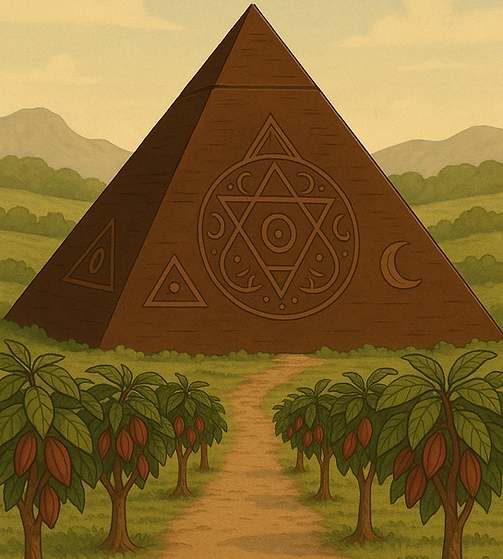
The Sacred Pyramid of
Chocolate City

The Royal House of The Browns, Keepers of Joy & Renewal

The Royal House of The Ivories, Keepers of Light

The Royal House of The Semis, Guardians of Balance & Harmony

The Royal House of The Cocos, Keepers of the Sacred Flame
"Continue Velah's Journey:
"Subscribe to The Chocolate Letter to receive new chapters every week, plus truffle stories and updates from
The Chocolate Muse"
At the edge of the known world, where dawn poured like melted gold across the horizon, a realm of impossible sweetness stirred awake. This was Chocolate Earth, a living tapestry of rivers that shimmered like cocoa silk, forests dusted with sugar frost, and a city whose towers rose in swirling ribbons of chocolate and light.
They called it Chocolate City, and for thousands of seasons it had endured under the guidance of Four Great Houses, each born from a different form of cacao magic.
The House of Browns — Earth Keepers
In the south, where the soil ran rich and dark, the House of Browns tended fields that pulsed with life. Vines braided around archways, cocoa trees bowed under heavy pods, and warm milk-chocolate rivers wound through the land like veins of comfort.
Their magic was grounding.
From milk chocolate, they drew:
-
Strength of body
-
Steadiness of heart
-
The warmth that made a house feel like home
Brown Guardians could coax a barren field into bloom with a single touch, or lay a hand upon trembling shoulders and quiet a storm inside a soul.
The House of Ivories — Light Stewards
To the east, where dawn first kissed the realm, the House of Ivories built shining spires of pale stone and sugar glass. Their towers reflected Lunessa’s silver light and Bronté’s golden fire, catching starlight even in the day.
From white chocolate, they shaped:
-
Clarifying radiance
-
Healing enchantments
-
Grace that mended unseen fractures
Their lanterns never burned with flame. Instead, each held a slow-melting shard of enchanted ivory chocolate, casting halos of soft glow that soothed the weary and revealed paths where none had been seen before.
The House of Semis — Dream Weavers
In the west, beneath skies tinted plum and indigo, the House of Semis crafted wonders. Their cities were bridges of suspended starlight, staircases that led into mist, and windows that opened not to streets, but to dreams.
Semi-sweet chocolate was their medium of choice, balanced between dark and light.
From it, they conjured:
-
Vision
-
Imagination
-
Stories that bent the future
They brewed dream-drinks that gave children courage, painted illusions into the night air, and whispered possibilities into sleeping minds. It was said a Semis spell could plant a dream so vivid it grew into destiny.
The House of Cocos — Shadow Forgers
Far to the north, where mountains rose in jagged silhouettes, the House of Cocos forged fortresses into obsidian cliffs. Their halls were lit not by brightness, but by the slow-burning glow of dark chocolate braziers—deep, steady, endlessly patient.
From dark chocolate, they harnessed:
-
Wisdom
-
Protection
-
The power to see through illusions
The Cocos were guardians of secrets no one else wanted to hold. When the borders of Chocolate Earth trembled, it was the Cocos who stepped forward, cloaking the realm in protective wards steeped in ancient, bitter cacao.
For as long as any could remember, the Four Great Houses had kept the realm in balance. They argued. They rivaled. They competed in craft, in influence, in pride. But when it mattered, they stood together.
Because beneath their cities, beneath the fields and rivers and mountains, beneath even the crust of chocolate-rock, the realm itself remembered a time before four. A time when there had been a Fifth House.
No sigils of that House remained in public sight.
No banners flew its colors.
No family claimed its name.
Yet in secret vaults, behind doors sealed with Cocos shadow and Ivories light, the elders preserved fragments:
-
A glyph of a circle inside an inverted triangle cradling a single radiant dot
-
A line of text half-erased: “When Velah returns…”
-
A faint map tracing a tower that no longer stood
Children heard only the tamest versions of the tale:
Once, there was a House of Stars who ruled them all.
Once, there was a Queen whose light held every realm together.
Once, she fell to save them.
In Chocolate City’s markets, some dismissed it as myth.
But the Houses’ oldest seers knew better.
They felt the hollow beneath their feet, the missing note in the realm’s song, the space where a forgotten power should have been.
And on this morning, as Lunessa sank behind Bronté and the sky blushed with rose and cocoa-gold, a shiver went through the city. The milk rivers rippled. The Ivory lanterns flickered. The Semi dream-bridges thrummed.
The Cocos braziers flared high, unbidden. Every head turned upward. Because high above Chocolate Earth, in the deep violet band of the fading night…the Seven Sisters constellation was burning again. For the first time in three thousand seasons.
Across the Four Houses, one quiet thought took shape in unison, like a prayer they did not dare to speak aloud:
“The Queen of the Fifth House has awakened.”
